
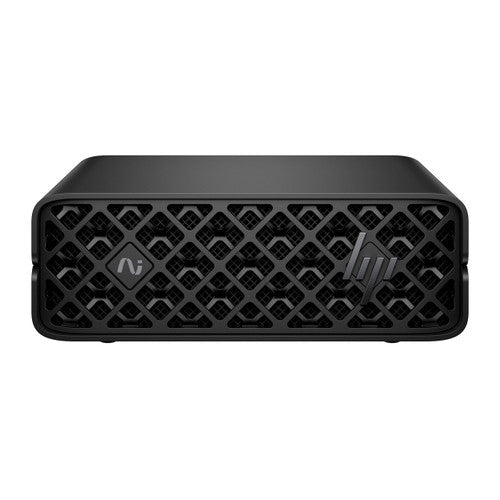
HP CZ2V8UT#ABA ZGX Nano G1n AI Station - Nvidia GB10 Processor - 128GB - 4TB SSD - NVIDIA Blackwell GPU Gigabit Ethernet
HPHP ZGX Nano G1n · NVIDIA GB10
AI supercomputing,
gone Nano.
The NVIDIA GB10 Grace Blackwell Superchip and 128 GB of unified memory, paired with HP’s ZGX Toolkit for prototyping, fine-tuning and inferencing — high-performance local AI compute in a Nano chassis.
- GB10 Grace Blackwell
- 128 GB unified memory
- 1 PetaFLOP FP4
- DGX OS

The silicon
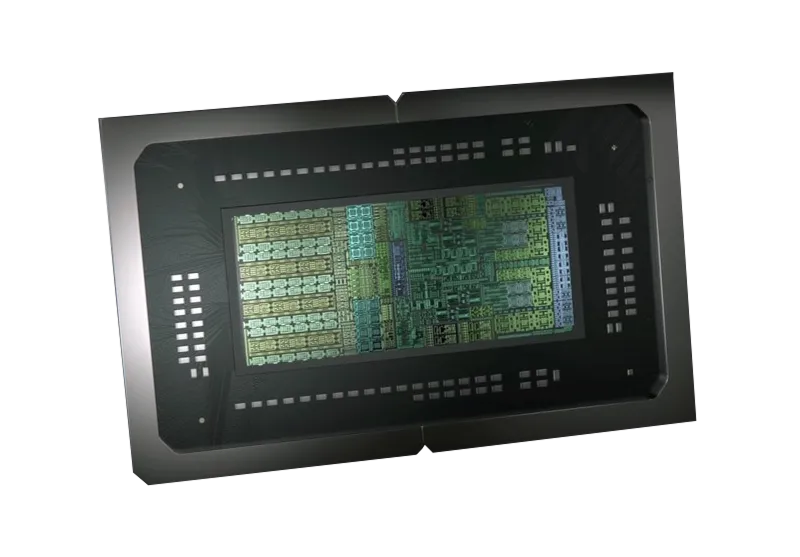
GB10 Grace Blackwell Superchip
A 20-core Arm CPU and a Blackwell GPU share one pool of memory over NVLink-C2C — no PCIe bottleneck between them. It is the architecture NVIDIA ships in DGX systems, on your desk.
- 20-core Arm CPU
- Blackwell GPU
- NVLink-C2C
Capacity
Room to run — and to scale
128 GB unified memory
Fine-tune models in the 30–70B range and run inference up to ~200B parameters — one pool, addressed by CPU and GPU alike, nothing to copy or partition.
Cluster when you outgrow one
The built-in NVIDIA ConnectX-7 NIC direct-connects two units — and scales to a four-unit cluster — when a single box isn’t enough.
Who it's for
Built for teams doing real AI work
Owned, local compute for the people who were paying for it by the hour.
Developers & ML researchers
Prototype and fine-tune in the 30–70B range; trade per-run cloud cost for a fixed, owned asset.
Regulated industries
Healthcare, finance and government teams that need on-prem, air-gapped-capable processing.
Research & academia
Capex-budget compute for imaging, genomics, astrophysics and coursework — no recurring cloud bill.
Robotics & edge vision
A local target for NVIDIA Isaac, Metropolis and Holoscan, from sensor processing to assistive tech.
Specifications
Technical specifications
- Superchip
- NVIDIA GB10 Grace Blackwell
- CPU
- 20-core Arm (10× Cortex-X925 + 10× Cortex-A725, 16 MB L2)
- GPU
- NVIDIA Blackwell — 5th-gen Tensor Cores, FP4
- AI performance
- Up to 1 petaFLOP (FP4)
- Unified memory
- 128 GB LPDDR5X — 273 GB/s
- Storage
- 4 TB PCIe NVMe OPAL M.2, self-encrypting (2 TB option)
- Networking
- NVIDIA ConnectX-7 (2× QSFP 200 Gbps) + Realtek 10 GbE
- Wireless
- Wi-Fi 7 · Bluetooth 5.4
- Rear I/O
- 1× USB-C power · 3× USB-C 20 Gbps · HDMI 2.1a · RJ-45 10 GbE · 2× QSFP
- Software
- HP ZGX Toolkit — IP discovery, model export, local serving
- Operating system
- NVIDIA DGX OS (Ubuntu Linux)
- Dimensions
- ~150 × 150 × 51 mm
Questions
Frequently asked questions
Who is the HP ZGX Nano G1n for?
AI developers, ML researchers, regulated-industry data scientists and research labs who want persistent, local AI compute — for fine-tuning in the 30–70B range and inference up to ~200B parameters.
Can it train large models from scratch?
It’s a fine-tuning and inference machine, not a from-scratch training cluster. For pretraining above ~70B parameters, look at NVIDIA DGX Station or a cloud cluster — we can advise on the right step up.
How does it compare to cloud GPUs on cost?
Cloud GPU sessions run roughly $2–$15 each and never stop. This turns that recurring opex into a fixed, owned asset — and keeps sensitive data on-prem.
What is the HP ZGX Toolkit?
HP’s curated open-source stack that reduces workflow friction — built-in IP discovery, model export and local serving — so prototyping, fine-tuning and inferencing produce repeatable, deployment-ready results.
How is it different from other DGX Spark systems?
Same NVIDIA GB10 platform, HP build: the ZGX Toolkit software layer, OPAL self-encrypting storage (2 TB or 4 TB) and HP’s Nano chassis. Core GB10 performance is shared across the DGX Spark family.
What AI applications does it support?
Generative AI (fine-tuning and running LLMs), computer vision, predictive analytics, and simulation and research — a versatile local AI machine across industries.