
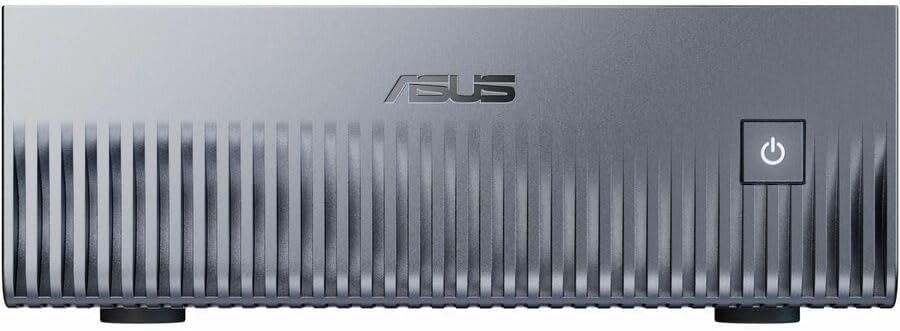
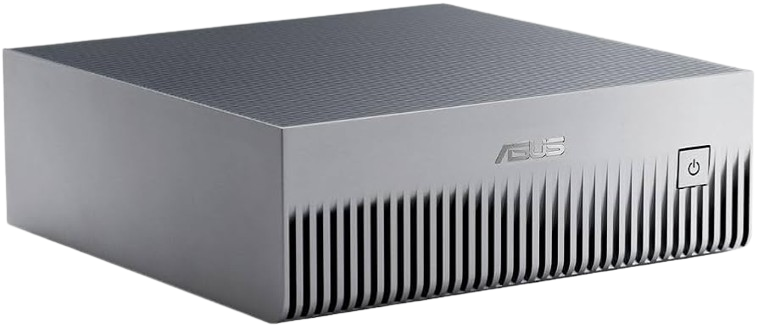
ASUS Ascent GX10-GG0010BN AI Computer ARM Cortex X925-128GB LPDDR5X 1TB NVMe SSD NVIDIA GB10 Grace Blackwell,DGX OS
AsusASUS Ascent GX10 · NVIDIA GB10
A petaFLOP of AI.
On your desk.
The GB10 Grace Blackwell Superchip and 128 GB of unified memory, in a chassis the size of a Mac mini — the DGX platform, at the smartest way in.
- GB10 Grace Blackwell
- 128 GB unified memory
- 1 PetaFLOP FP4
- DGX OS
The silicon
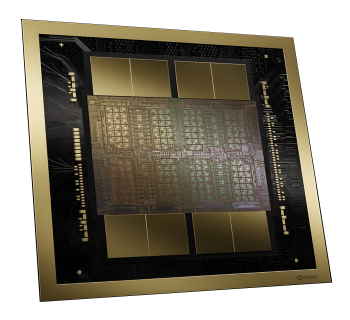
GB10 Grace Blackwell Superchip
A 20-core Arm CPU and a Blackwell GPU share one memory space over NVLink-C2C — no PCIe bottleneck between them. It is the architecture NVIDIA ships in DGX systems, on your desk.
- 20-core Arm CPU
- Blackwell GPU
- NVLink-C2C
Capacity
Room to run — and to scale
128 GB unified memory
Fine-tune models in the 30–70B range and run inference up to ~200B parameters — one pool, addressed by CPU and GPU alike, nothing to copy or partition.
Cluster when you outgrow one
The built-in NVIDIA ConnectX-7 NIC direct-connects two units — and scales to a four-unit cluster (per ASUS) — when a single box isn’t enough.
Who it's for
Built for teams doing real AI work
Owned, local compute for the people who were paying for it by the hour.
Developers & ML researchers
Prototype and fine-tune in the 30–70B range; trade per-run cloud cost for a fixed, owned asset.
Regulated industries
Healthcare, finance and government teams that need on-prem, air-gapped-capable processing.
Research & academia
Capex-budget compute for imaging, genomics, astrophysics and coursework — no recurring cloud bill.
Robotics & edge vision
A local target for NVIDIA Isaac, Metropolis and Holoscan, from sensor processing to assistive tech.
Connectivity
Everything plugs in around the back
Four USB-C ports (all 20 Gbps, all DisplayPort 2.1), HDMI 2.1b, 10 GbE wired networking — and the headline act, a dual-port NVIDIA ConnectX-7 for stitching units together. It even takes its power over USB-C.

- Kensingtonlock slot
- USB-C ×120G · 180 W PD in
- USB-C ×320G · DP 2.1
- HDMI 2.1bdisplay out
- 10 GbEwired LAN
- ConnectX-7cluster NIC
Specifications
Technical specifications
- Superchip
- NVIDIA GB10 Grace Blackwell
- CPU
- 20-core Arm
- GPU
- NVIDIA Blackwell — 5th-gen Tensor Cores, FP4
- AI performance
- Up to 1 petaFLOP (FP4)
- Unified memory
- 128 GB LPDDR5X, coherent — NVLink-C2C (5× PCIe 5.0 bandwidth)
- Storage
- NVMe SSD — capacity by configuration (choose above)
- Networking
- NVIDIA ConnectX-7 NIC + 10 GbE LAN
- Rear I/O
- 4× USB-C 20 Gbps (DisplayPort 2.1) · HDMI 2.1b · Kensington lock
- Power
- 180 W in over USB-C (EPR PD 3.1)
- Operating system
- NVIDIA DGX OS (Ubuntu Linux)
- Dimensions
- 150 × 150 × 51 mm · 1.6 L toolless chassis
Questions
Frequently asked questions
Who is the ASUS Ascent GX10 for?
AI developers, ML researchers, regulated-industry data scientists, research labs and robotics teams who want persistent, local AI compute — for fine-tuning in the 30–70B range and inference up to ~200B parameters.
Can it train large models from scratch?
It’s a fine-tuning and inference machine, not a from-scratch training cluster. For pretraining above ~70B parameters, look at NVIDIA DGX Station or a cloud cluster — we can advise on the right step up.
How does it compare to cloud GPUs on cost?
Cloud GPU sessions run roughly $2–$15 each and never stop. The GX10 turns that recurring opex into a fixed, owned asset — and keeps sensitive data on-prem.
What comes in the box?
The GX10 itself — GB10 Superchip, 128 GB unified memory, the built-in ConnectX-7 NIC, and NVIDIA DGX OS (Ubuntu) with the AI stack preloaded. Ask us to confirm exact in-box contents for your configuration.
What are the main differences between the Ascent GX10 and NVIDIA DGX Spark?
The ASUS Ascent GX10 showcases meticulous engineering with a thermal design built to handle demanding workloads effortlessly. Every element of its cooling system reflects careful craftsmanship, ensuring sustained high performance in an impressively compact form.
What AI applications does the Ascent GX10 support?
The Ascent GX10 supports a wide range of AI workloads. In generative AI, it enables fine-tuning and running large language models (LLMs) for advanced chatbots and virtual assistants. It also excels in computer vision tasks such as object detection and tracking, as well as predictive analytics for risk assessment and demand forecasting. Finally, the GX10 is well-suited for simulation and research, making it a versatile AI computing solution for multiple industries.